



What Is Experiential Marketing?
What is experiential marketing, and how do you do it?
Experiential marketing is marketing that lets people do something rather than only see or hear a message. A person tries the product, plays the game, meets the team or takes part in a live moment, and the brand is part of that experience.
The idea is that people remember and trust what they have done more than what they have been told. Experiential marketing is also called engagement marketing, live marketing or participation marketing.
This guide defines it, separates it from event marketing and advertising, lists the common formats, gives planning steps and explains how to measure it. It is about the marketing approach. For events built around participation, see the experiential events page.
Updated by the Eventdex team



4.7/5 from 39 reviews on each
Experiential marketing: the plain definition
Experiential marketing is a promotional approach in which the audience takes part in an experience that represents the brand or product. The experience is the message.
It can happen in person, online or in both, and it can be a stand-alone activity or part of a larger event. What makes it experiential is participation: the person acts, and what they do creates the memory.
Participation
The audience does something: tries, plays, builds, votes or meets.
Relevance to the brand
The activity connects to what you sell or stand for, not just a game for its own sake.
A measurable outcome
You decide in advance what the experience is meant to produce, such as sign-ups, trials, leads or conversations.
How it differs from event marketing and advertising
The three overlap, and one campaign can use all of them. The table shows the main difference in each.
| Approach | What it is | The audience | The main strength |
|---|---|---|---|
| Advertising | A message placed in media | Sees or hears it | Reach |
| Event marketing | Using events to reach people and build relationships | Attends | Relationships and leads |
| Experiential marketing | A hands-on experience built around the brand | Takes part | Memory and involvement |
Common experiential marketing formats
Most experiential work falls into a handful of formats. Choose the one that suits your audience and the amount of staffing you can provide.
Pop-up experiences
A short-lived, hands-on space in a public place or inside a larger event.
Product trials and demos
People use the product for themselves, guided by staff.
Event and trade show activations
Interactive moments built into a booth, session or sponsorship.
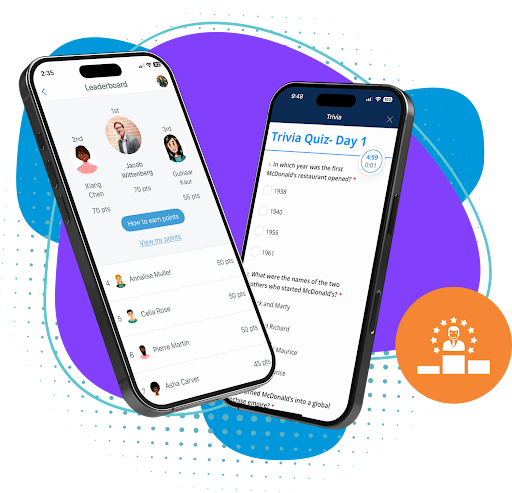
Brand activation ideasGame and challenge formats
Quizzes, scavenger hunts and point-based challenges with a prize.
Trivia and leaderboardsVirtual and hybrid experiences
Online sessions, live polls and matched meetings that remote people can join.
Virtual speed networking
How to plan an experiential campaign
Plan it like any marketing campaign, with the experience designed backward from the result.
Define the outcome
Choose the one result that matters most, such as qualified leads, trial sign-ups or conversations.
Describe the participant
Say who you want to take part, what they care about and where they will be.
Design the experience
Pick one core activity people can complete in a few minutes, and tie it to the product or message.
Plan the capture
Decide how participants will opt in, what you will ask and how it will reach your team or CRM.
Staff and rehearse
Brief the team on the activity, the script and the next step. Walk through it once before opening.
Run, measure and follow up
Count what happened, follow up soon and compare results with the outcome you set.
How to measure experiential marketing
Measure what people did, then what they did afterward. Choose measures that match the outcome from step one.
| Question | Measure | How to collect it |
|---|---|---|
| Did people take part? | Participants, completions | Sign-in, scans or a counted queue |
| Did they engage? | Time spent, interactions, points | Activity logs, games, polls |
| Did they become leads? | Contacts captured and qualified | Scans, forms and notes |
| Did they act afterward? | Follow-up replies, trials, meetings | Your CRM and email results |
| What did they think? | Satisfaction and comments | A short survey |
Mistakes to avoid
Experiential campaigns go wrong in familiar ways.
An activity with no link to the brand
A fun game that nobody connects to the product does not help the brand.
No capture plan
If you do not collect opt-in contacts or signals, you cannot follow up or measure.
Long queues
Keep the core activity short, or provide more than one station.
Ending when the event ends
The follow-up message is part of the experience. Plan it before launch.
Where Eventdex fits
Eventdex is an event platform, not an experiential agency or a creative studio. It does not design or build physical installations. It does supply the participation and capture tools that make an event experiential, as described on its own pages.
Experiential events
Eventdex's page on experiential events covers formats and the engagement tools that make an event participatory, with measures such as check-ins, poll responses and leaderboard participation.
Experiential events guideGamification
Points and challenges for visiting booths, attending sessions and answering questions.
Event gamificationMatchmaking and meetings
AI-recommended meetings that attendees can schedule in the event app.
AI business matchmaking
The Eventdex platform
Participation tools for experiential events
- Trivia and leaderboardsLive quiz rounds and real-time leaderboards, branded to your event.Learn more about Trivia and leaderboards
- Event gamificationPoints and challenges for booth visits, sessions and answers.Learn more about Event gamification
- AI matchmakingRecommended meetings, scheduled in the event app.Learn more about AI matchmaking
- Event surveysSession and post-event surveys to measure what landed.Learn more about Event surveys
“Eventdex helped me run a smooth registration process during my event and helped me deliver an excellent mobile application to my event's attendees. Their support team was brilliant and I really enjoyed incorporating the Eventdex solutions into my events.”
 University at Buffalo
 Eversource Energy
 Georgia Tech
 Influence Communications
FAQ
What Is Experiential Marketing?: common questions
What is experiential marketing?
Experiential marketing is marketing that invites people to take part in an experience that represents a brand or product, such as a trial, a game or a live moment, rather than only seeing an advertisement.
Is experiential marketing the same as event marketing?
No, though they overlap. Event marketing uses events to reach people and build relationships. Experiential marketing is the participatory, hands-on part, and it can happen at an event or outside one.
How is it different from advertising?
Advertising places a message in front of an audience. Experiential marketing asks the audience to do something, so it trades reach for involvement.
What are examples of experiential marketing?
Pop-up experiences, product trials, interactive booth activities, quizzes with leaderboards, scavenger hunts and live polls. See the brand activation ideas guide for options by setting.
How do you measure experiential marketing?
Count participation first, then engagement, contacts captured and qualified, and actions afterward such as meetings or trials. A short survey adds what participants thought.
Does Eventdex build experiential installations?
No. Eventdex is an event platform. Its pages describe gamification, live Q&A and polls, matchmaking, lead capture and surveys, which support an experiential event, but they do not describe designing or building physical experiences.
Give your attendees something to do
Start with a free interactive floor plan, or talk to an event specialist on +1 (866) 434-5088.