

Free Event Management Software
What does free event management software really cost?
Free event management software almost never means free forever for every event. It usually means one of a few things: a free plan with limits, a trial that ends, free tickets for free events with fees on paid ones, or open-source code that is free to download and costs time to run. The word on the page is not the same as the bill at the end.
This guide explains the common meanings of free, the limits to check, a checklist for the real cost, and a table to decide when free is enough and when it is not. It also says plainly what Eventdex offers for free, which is narrow, and what it does not.
Updated by the Eventdex team


4.7/5 from 39 reviews on each
What free usually means
When a tool says free, find out which of these it is. They behave very differently once your event grows or turns into a paid one.
It also helps to ask what the vendor gets from the free offer. Some use it to bring in a small event that later grows into a paying customer, some earn on payment fees, and some limit the free plan so that anyone with a serious event has to upgrade. Knowing the model tells you where the limits will be.
A free plan
Real use with limits, such as a cap on attendees, events or features. It stays free as long as you stay inside the limits.
A free trial
Full or near-full features for a set time. It is free only until the clock runs out, and moving data afterwards takes effort.
Free for free events
No charge when tickets are free, with a fee or commission on paid tickets. Fine for a free meetup, costly the day you add a ticket price.
Free software, paid payments
The tool is free but payment processing is not, because the payment provider charges its own fee on card payments.
Open source
The code is free. Hosting, setup, security, updates and support are on you, or on someone you pay.
The limits to check before you commit
Read the plan page for numbers and conditions, not the headline. These are the limits that most often turn free into a problem:
| Limit | What to ask | Why it matters |
|---|---|---|
| Attendees or tickets | Is there a cap per event or per month? | A sold-out event can be a bigger event than the plan allows |
| Events | How many events are included? | A series of events may exceed it |
| Features | Are check-in, badges, reports and exports included? | A free plan may lock the features you need on the day |
| Branding | Is the vendor's branding forced onto your pages and emails? | It may matter for a corporate or client event |
| Data export | Can you export attendee data without upgrading? | You need the list for follow-up and your CRM |
| Support | Is any support included? | Free plans may include little or no support |
| Payments | Which payment providers are supported, and who pays the processing fee? | The fee exists even when the software is free |
| Terms | Can the free plan change or end? | Plans change; your event date does not |
The cost-of-free checklist
Free software has costs that never appear on the price page. Add them up before you decide:
A simple way to do this is to price your own event. Write down the expected number of attendees, the ticket price and the number of paid tickets, then work through each line below with real numbers. The comparison between a free plan and a paid plan often flips once the event sells more than a handful of tickets.
Transaction fees
A commission or per-ticket fee on paid tickets, plus the payment provider's processing fee. Multiply by your expected sales.
Your time
Setup, workarounds for missing features and fixing problems with no support. Count the hours and put a value on them.
Missing features you replace
If check-in, badges or reporting are not included, what will you use, and what does it cost?
Data and exit
How hard is it to take your attendee data elsewhere, and will you need to?
Growth
What happens at the next size of event, and is the next tier a small step or a big jump?
Reliability on the day
A free tool you cannot get help with is a risk at a door with a queue.
When free is enough and when it is not
Free is a sound choice for some events and a false saving for others. The decision turns on size, payments and what must work on the day.
Read the table by row, and mark each row for your own event. If most of your answers sit in the first column, a free plan is a reasonable place to start, and you can move later if the event grows. If two or three sit in the second column, especially tickets, the door or risk, get a quote for a paid plan and compare the full cost before you decide.
| Your situation | Free is likely enough | Look at a paid or quoted plan |
|---|---|---|
| Size | A small gathering, a meetup or a club night | Hundreds of attendees or a multi-day event |
| Tickets | Free tickets only | Paid tickets, where fees add up |
| Door | A paper list or a simple check | Scanning, badges and queues to manage |
| Reporting | A headcount is enough | Sponsors, boards or clients want reports |
| Data | You rarely follow up | You follow up in a CRM |
| Risk | A failure would be an inconvenience | A failure would cost money or reputation |
Free event software for nonprofits
Nonprofits search for free software because every dollar of the event budget counts, and that is a good reason to check transaction costs closely. A free plan that takes a commission on donations or tickets can cost more than a paid plan with none, once an event raises real money.
Ask three things. What fee applies to donation and ticket sales, in total, including the payment provider's. Does any discount or special pricing for nonprofits exist, and on what terms. And can the tool support the way you collect money, such as tickets, donations or pledges, without a workaround. Where you cannot get a clear answer in writing, treat the free label with caution.
Compare the full fee
Add the software fee and the payment fee, and compare on a realistic event total.
Check the donation path
Make sure a donation or a ticket works without an extra tool.
Plan for the next event
A tool you outgrow midway through a campaign costs more than one that scales.
How to test a free tool in an afternoon
Before you build your event on any free tool, run a small trial that mimics the day. It takes a few hours, and it is far cheaper than finding a limit when tickets are already on sale.
Do it with another person if you can, so that one of you plays the attendee and the other plays the organizer at the door.
Write your must-haves
List what has to work: registration form, tickets, payments, check-in, a list export.
Build a dummy event
Create it end to end, including a paid ticket if you will sell one.
Register as an attendee
Use a phone, and see what the buyer sees, including any branding that is not yours.
Check in a few people
Test the door process you will really use, offline if connectivity is poor.
Export the data
Download the attendee list. If this requires an upgrade, you have found a limit.
Ask support a question
See whether you get an answer at all.
What Eventdex offers for free
Eventdex is not a free platform, and pricing is by quote on the pricing page. Two parts of the product are relevant to the word free, and they are narrow:
Neither is a free trial of the whole event platform, and neither should be read as one. If you want to see more of the product, such as registration, badges or check-in, ask for a demo and a quote sized to your event.
A free interactive floor plan
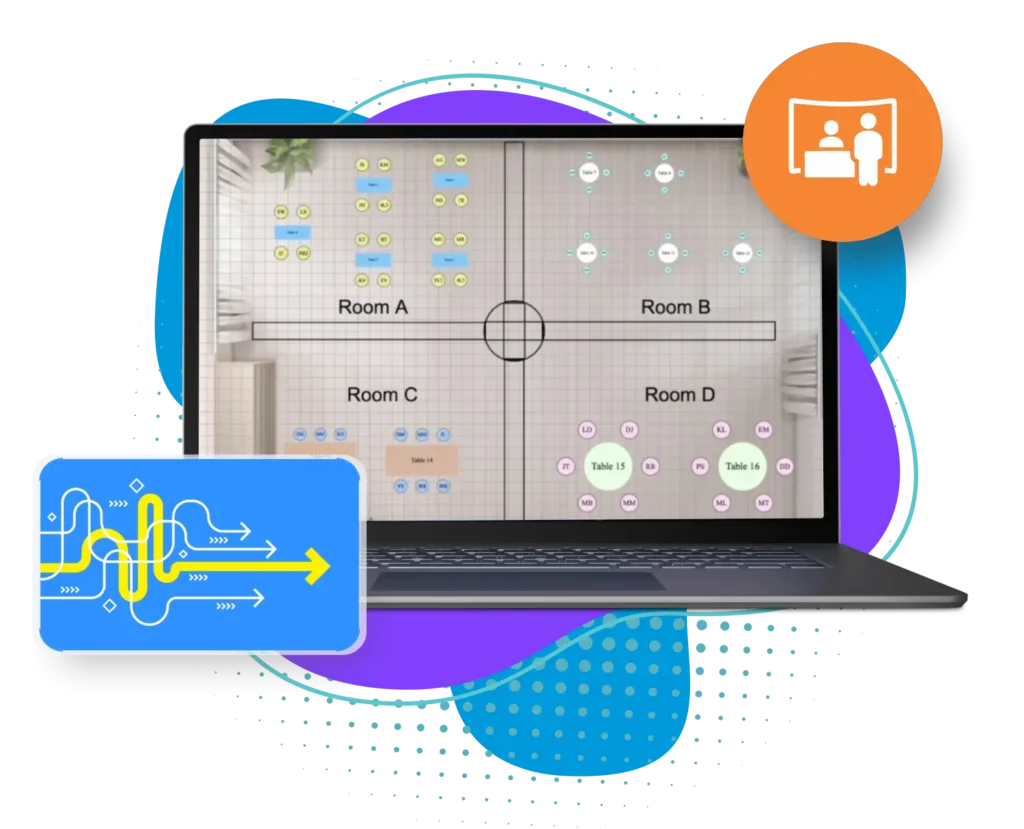
Create a free account and build one event's floor plan: upload your layout, place and number booths, and mark them open, reserved or sold, with no card and no contract. Publishing the map to your event site, sharing it with exhibitors and selling booths through it are what a paid plan adds.
Free interactive floor plan0% commission ticketing
Eventdex charges no commission on ticket sales, which is different from the whole platform being free. Payment gateways, such as Stripe or PayPal, set their own processing fees, so check with your gateway.
0% commission ticketingPricing
Plans are sized to your event, so ask for a quote rather than expecting a price list.
Eventdex pricing
The Eventdex platform
What is free and what is quoted
- Free floor plan builderBuild one event's floor plan with no card.Learn more about Free floor plan builder
- 0% commission ticketingNo commission on ticket sales.Learn more about 0% commission ticketing
- PricingPlans sized to your event, by quote.Learn more about Pricing
- Registration softwareForms, ticketing, payments and check-in.Learn more about Registration software
“Eventdex helped me run a smooth registration process during my event and helped me deliver an excellent mobile application to my event's attendees. Their support team was brilliant and I really enjoyed incorporating the Eventdex solutions into my events.”
 University at Buffalo
 Eversource Energy
 Georgia Tech
 Influence Communications
FAQ
Free Event Management Software: common questions
Is free event management software really free?
Sometimes, within limits. Check the attendee cap, the features included, whether fees apply to paid tickets and what the payment provider charges. Free usually describes the plan, not your total cost.
What changes when I sell paid tickets?
Fees. Many free plans charge a commission or fee on paid tickets, and the payment provider charges its own processing fee. Work out the total on your expected sales.
Is there free event software for nonprofits?
Some free plans suit small nonprofit events. Compare the full fees on donations and tickets, ask whether special pricing exists and get the answers in writing.
Is Eventdex free?
No. Eventdex offers a free interactive floor plan for one event, with publishing and booth sales on a paid plan, and 0% commission on ticket sales. The platform is priced by quote.
Is open-source event software a good free option?
It can be, if you have someone to host, secure and maintain it. The code is free, but the time and the risk of running it yourself are not.
Get a quote for your event on Eventdex
Start with a free interactive floor plan, or talk to an event specialist on +1 (866) 434-5088.