


Trade Show ROI
How do you measure the ROI of a trade show?
Trade show ROI is what you got back from exhibiting compared with what you spent. The spend is easy to add up. The return is harder, because a lead met in March may close in September, and a conversation at a booth may only be one of several touches before a purchase. That does not make ROI unmeasurable. It means you decide, before the show, what you will count and how you will track it.
This guide is for the exhibitor. It covers the costs to include, how to set goals, how to track leads so they can be tied to revenue later, the formulas, and the follow-up that decides whether the leads pay off. It ends with a worksheet you can copy. The example figures in the tables are round numbers for illustration only; use your own.
Updated by the Eventdex team


4.7/5 from 39 reviews on each
Count every cost, not just the booth fee
The most common ROI mistake is counting only the booth rental. Honest ROI includes everything the show cost you, including staff time, because that is time not spent on other work. If you leave costs out the percentage looks better and the next decision is worse.
List the costs in the worksheet below by category. Where you do not have an exact number, use your best estimate and mark it as an estimate. If you also sponsored something at the show, include the sponsorship fee. The trade show budget guide has the full category list.
Direct costs
Booth space, booth build or rental, graphics, furniture, power, internet, and shipping and handling.
People costs
Travel, hotel, meals and the staff time at the show, including set-up and the days before and after.
Marketing and follow-up
Pre-show promotion, giveaways, lead capture tools and the cost of the follow-up campaign.
Sponsorship and extras
Sponsored sessions, lists, signage or receptions you bought on top of the booth.
Trade show budget guide
Set goals you can measure
ROI is measured against a goal. A show that costs more than it returns in revenue may still be worth it if the goal was awareness, partnerships or meeting existing customers, but only if you decided that on purpose and can show it. Write the goals before the show and attach a number to each from your own plans.
Use a small set of measures that match the goal. For revenue goals, measure qualified leads, opportunities and closed business. For relationship goals, measure meetings held and accounts reached. For awareness goals, measure conversations and follow-up engagement. The event KPIs guide covers the wider set of measures.
| Goal | What to count | Where to find it |
|---|---|---|
| Generate sales leads | Qualified leads, opportunities, closed deals | Lead capture export, then your CRM |
| Meet existing customers | Meetings held, accounts visited | Meeting schedule, booth notes |
| Launch a product | Demos given, sign-ups, press contacts | Demo log, sign-up form |
| Build awareness | Conversations, scans, follow-up opens | Booth scans, email results |
Track leads so you can tie them to revenue
A lead you cannot trace back to the show cannot count toward ROI. Capture every lead the same way, tag it with the show, and record enough about it at the booth to qualify it later. A pile of business cards fails this test; a scan with a few qualifier answers passes.
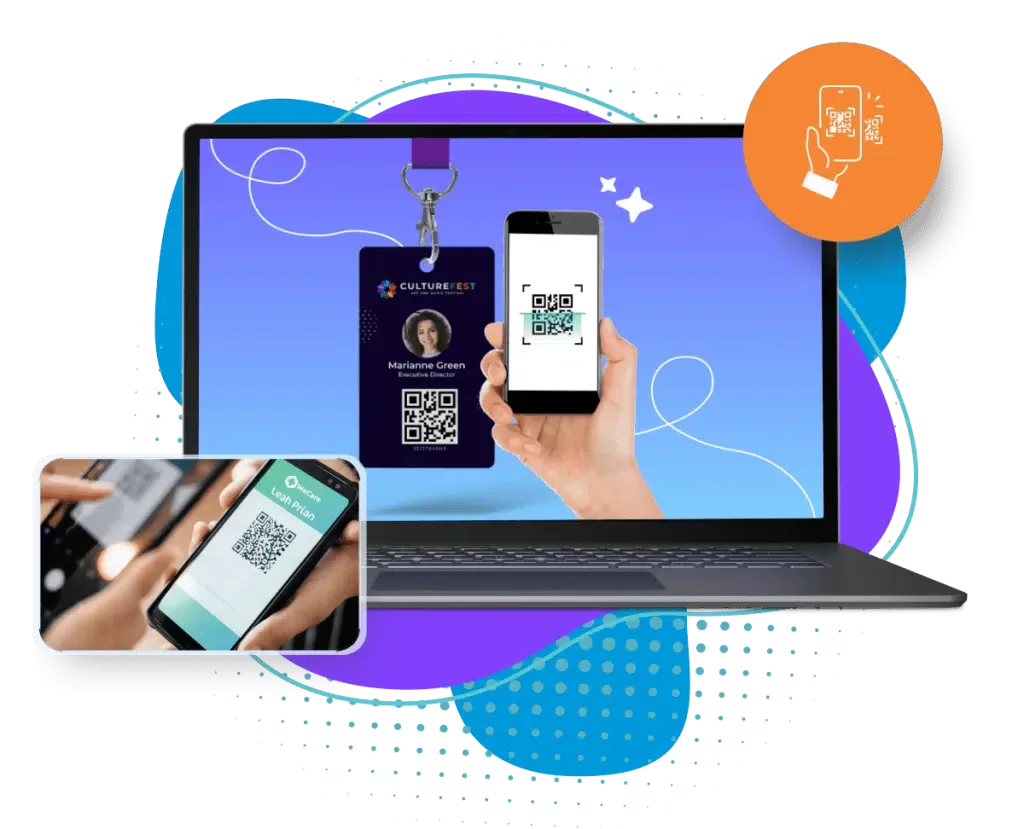
Eventdex's lead capture app lets booth staff scan an attendee's badge QR code on a phone or tablet and collect answers on custom forms, and it supports lead scoring and grading. It works with CRM and marketing automation tools, so leads can reach the system where you track opportunities. On Eventdex events, exhibitor leads can be exported as a CSV or sent to Salesforce, per the exhibitor management page. Eventdex does not calculate your ROI; it gives you the lead data to do it with.
Scan, do not collect cards
A badge scan records the contact in a structured way and avoids retyping later.
Lead capture appAsk two or three qualifying questions
Interest level, timeline and the next step. These let you score leads and decide who gets a call first.
Tag the source
Mark every lead with the show name so the CRM can report revenue by source.
Lead retrieval app for trade shows
The formulas, with example figures
There are four numbers worth working out: total cost, cost per lead, cost per qualified lead and ROI itself. The table shows each formula and a worked example. The example figures are round and made up for illustration only. Replace them with your own.
Treat ROI as a range that firms up over time. Right after the show you can count leads and cost per lead. Revenue arrives later, so come back to the same worksheet at the end of your sales cycle and update it.
| Measure | Formula | Example only | Your figure |
|---|---|---|---|
| Total cost | Sum of all costs from the worksheet | 10,000 | _____ |
| Leads captured | Count of scans and form entries | 200 | _____ |
| Cost per lead | Total cost divided by leads captured | 10,000 / 200 = 50 | _____ |
| Qualified leads | Leads that meet your qualifying rule | 40 | _____ |
| Cost per qualified lead | Total cost divided by qualified leads | 10,000 / 40 = 250 | _____ |
| Revenue from the show | Closed business traced to the show | 30,000 | _____ |
| ROI percent | (Revenue minus cost) divided by cost, times 100 | (30,000 - 10,000) / 10,000 x 100 = 200 | _____ |
Follow up fast, because that is where the return is
Most of the return comes after the show. A lead that hears from you soon after the show is easier to pick up than one contacted weeks later, while the conversation is still fresh. Plan the follow-up before you travel: who calls the hot leads, who sends the email to the rest, and what each message says.
Segment by the qualifier answers. Contact the strongest leads personally, send a useful message to the middle group and a lighter touch to the rest. The event follow-up email guide has wording you can adapt. Record every response in the CRM so the revenue can be traced back to the show.
Assign owners before the show
Every lead has a named person responsible for the first contact.
Segment the list
Hot, warm and cool leads each get a different message and timing.
Event follow-up email guideUpdate the worksheet
Return to ROI at the end of your sales cycle, when revenue is known.
What ROI misses, and how to say so
ROI from leads and closed deals does not capture everything. Existing customers met at the booth may renew more easily. Your presence may have kept a prospect from drifting to a competitor. A partner conversation may pay off years later. Do not invent numbers for these. Record them as notes beside the ROI figure so the decision-makers see the whole picture.
Compare shows with the same method. A consistent worksheet, kept for every show, lets you compare shows with each other, drop the weak ones and spend more on the strong ones. The comparison is more useful than any single ROI percentage.
Share the result inside the company. A one-page summary of cost, leads, qualified leads and what is still open, circulated within a week and again at the end of the sales cycle, turns the worksheet into a decision. It also gives the sales team a reason to follow up on their leads, because they know the numbers will be reviewed.
Note the unmeasured
Customer meetings, partner talks and press contacts get a line in the worksheet, without a made-up figure.
Keep one method
Use the same costs and the same formulas for every show so results compare.
Review with the team
Hold a short debrief within a week and record what to change.
Event ROI on Eventdex
Trade show ROI worksheet
Copy the worksheet into a spreadsheet or document and fill it in as costs arrive, not after the show. Leave the revenue section empty until deals close, then come back to it.
Trade show ROI worksheet
TRADE SHOW ROI WORKSHEET

Show: [name]
Dates: [dates]
Booth size and number: [details]
Owner: [name]

GOALS
1. [goal] Measure: [number or outcome]
2. [goal] Measure: [number or outcome]

COSTS
Booth space: $_____
Booth build or rental, graphics: $_____
Furniture, power, internet: $_____
Shipping and handling: $_____
Travel and hotel: $_____
Meals: $_____
Staff time (hours x hourly cost): $_____
Pre-show promotion: $_____
Giveaways and printed material: $_____
Lead capture tools: $_____
Sponsorship or extras: $_____
Follow-up campaign: $_____
Other: $_____
TOTAL COST: $_____

RESULTS (update over time)
Leads captured: _____
Qualified leads: _____
Meetings held: _____
Opportunities created: _____
Deals closed: _____
Revenue traced to the show: $_____

CALCULATIONS
Cost per lead = total cost / leads captured = _____
Cost per qualified lead = total cost / qualified leads = _____
ROI percent = (revenue - total cost) / total cost x 100 = _____

NOT MEASURED, BUT NOTED
Customer meetings: [notes]
Partner or press contacts: [notes]
Competitor presence: [notes]

DECISION
Exhibit again? [yes / no / change]
What to change: [notes]
Date reviewed: [date]
The Eventdex platform
Lead data you can take to your ROI worksheet
- Lead capture appBadge QR scanning, custom forms and lead scoring and grading.Learn more about Lead capture app
- Lead retrieval for trade showsLead retrieval for exhibitors and booth teams.Learn more about Lead retrieval for trade shows
- Exhibitor managementExhibitor portal, booth staff and lead exports.Learn more about Exhibitor management
- Event ROIA guide to the event ROI formula and what to count as cost and return.Learn more about Event ROI
“Eventdex helped me run a smooth registration process during my event and helped me deliver an excellent mobile application to my event's attendees. Their support team was brilliant and I really enjoyed incorporating the Eventdex solutions into my events.”
 University at Buffalo
 Eversource Energy
 Georgia Tech
 Influence Communications
FAQ
Trade Show ROI: common questions
What is the formula for trade show ROI?
Subtract your total cost from the revenue traced to the show, divide by the total cost, and multiply by 100. The result is a percentage. Revenue often arrives months later, so update the figure at the end of your sales cycle.
Which costs should I include?
All of them: booth space and build, shipping, travel, hotel, meals, staff time, promotion, giveaways, lead capture tools, sponsorship and the follow-up campaign. Leaving costs out makes ROI look better and weakens the decision.
What if my goal is awareness, not sales?
Measure what matches the goal, such as conversations, scans and follow-up engagement, and say so in the worksheet. A show can be worth attending without a revenue return, but the decision should be explicit and recorded.
When should I calculate ROI?
Calculate cost per lead right after the show and revisit ROI when deals close. A short sales cycle can be reviewed in a few months; a long one needs a longer window.
Does Eventdex calculate trade show ROI?
No. Eventdex provides the lead capture app, with badge scanning, custom forms and lead scoring, and exports of the leads. You use that data, with your costs and CRM revenue, to calculate ROI in your own worksheet.
Capture trade show leads you can trace to revenue
Start with a free interactive floor plan, or talk to an event specialist on +1 (866) 434-5088.