



Event Logistics Checklist
What is event logistics, and what goes on the checklist?
Event logistics is the practical side of an event: getting the venue, people, equipment, supplies and information to the right place at the right time, and having a plan for when something goes wrong. It covers the venue and its layout, suppliers such as catering and AV, deliveries and load-in, power and Wi-Fi, transport and accommodation, registration and check-in, signage, staffing, accessibility and safety.
The checklist below is organized by area, with the point in the timeline when each item usually needs confirming. After it come a countdown for the final month and the habits that keep logistics under control: one master document, a named owner for every line, written confirmations and a plan B for the things most likely to fail. It suits conferences, trade shows and corporate events; scale it down for a smaller meeting.
Updated by the Eventdex team



4.7/5 from 39 reviews on each
What event logistics covers
Planning decides what the event is: the goal, the audience, the program and the budget. Logistics makes it happen physically. A useful test: if a task involves a delivery, a vehicle, a room, a cable, a queue or a person standing somewhere at a set time, it is logistics.
Most logistics problems on the day trace back to one of three causes. Something was assumed rather than confirmed in writing. Nobody owned a task that sat between two suppliers. Or a single point of failure, such as one printer, one internet connection or one person with the keys, had no backup. The checklist and tips below are built around those three.
Venue and layout
Rooms, capacities, the floor plan, furniture, access times and house rules.
Suppliers
Catering, AV, staging, furniture, signage, security and cleaning, each with a confirmed order and a named contact.
Movement
Deliveries, load-in and load-out, parking, shuttles, and accommodation for speakers and staff.
Attendee flow
Registration, check-in, badges, wayfinding and session rooms.
People
Staff and volunteers, with their roles, shifts and briefings.
Contingency
Backups for power, internet, printers and key people, plus the venue's emergency procedures.
The event logistics checklist
Copy this into your planning document and add an owner and a status column. The lead times suit a mid-sized conference; book earlier in busy seasons or popular cities.
| Area | What to confirm | When |
|---|---|---|
| Venue | Contract, rooms and capacities, access hours, house rules, insurance requirements and the venue's emergency procedures | 6 to 12 months before |
| Floor plan | Room sets, booth layout, aisles, stage, registration area, catering points and accessible routes, drawn to scale | 3 to 6 months before |
| Catering | Menus, service times, numbers, dietary requirements and where food and drink are served | Order 1 to 2 months before; final numbers about a week before |
| AV and production | Microphones, screens, projectors, staging, lighting, recording or streaming, and technician hours | 2 to 3 months before |
| Power and internet | Power where you need it, a dedicated network or wired line for registration, and a backup connection | 1 to 2 months before |
| Deliveries and load-in | Delivery slots, dock or loading access, storage, who signs for what, and the load-out deadline | 2 to 4 weeks before |
| Transport and parking | Parking, shuttles, airport transfers, drop-off points and directions | 1 to 2 months before |
| Accommodation | Room blocks for speakers, staff and VIPs, with names and dates confirmed | 3 to 6 months before |
| Registration and check-in | Check-in method, number of stations, devices, staff, the walk-in process and opening time | 1 to 2 months before |
| Badges | Badge design, stock, printers, lanyards, and whether badges are pre-printed or printed at check-in | 1 to 2 months before |
| Signage and wayfinding | Directional and room signs, sponsor signs, the agenda board and the floor map in the event app | 3 to 4 weeks before |
| Staff and volunteers | Roles, shifts, briefings, radios or a group chat, meals and a contact sheet | 2 to 4 weeks before |
| Accessibility | Step-free routes, seating, captioning or interpreters, a quiet room, and requests collected at registration | From venue selection onward |
| Health, safety and security | Security staff, first aid, the venue's evacuation plan, lost and found, and incident reporting | Agree with the venue 1 to 2 months before |
| Exhibitors | Move-in times, booth packages, power and internet orders, the shipping address and the exhibitor manual | 2 to 3 months before |
| Load-out and returns | Teardown order, rental returns, waste and recycling, and a final walk-through with the venue | Planned 2 weeks before; done after the event |
Event logistics countdown: the final month
Most logistics work lands in the last four weeks. A simple countdown keeps it in order:
Four weeks out
Send every supplier a written summary of what they are providing, when and where, and ask them to confirm it. Lock the floor plan and send it to the venue, AV and exhibitors.
Two weeks out
Confirm delivery and load-in slots, staff shifts and the check-in plan. Test badge printing with the real badge stock and printers.
One week out
Give catering final numbers, print signage, send the know-before-you-go email to attendees, and share the contact sheet with everyone working the event.
The day before
Walk the venue with the venue manager. Set up and test registration, Wi-Fi, power, AV and printers, then brief staff and volunteers.
Event day
Open check-in early, keep one person free to solve problems rather than staff a station, and log issues as they happen.
After the event
Supervise load-out, return rentals, check supplier invoices against what was delivered, and write down what to change next time.
Event logistics management tips
A checklist tells you what to do. These habits make sure it actually gets done:
Keep one master document
A single logistics sheet with every item, its owner, its supplier contact and its status. When details live in email threads, things get missed.
Name an owner for every line
A person, not a team. Gaps usually sit between two suppliers, such as who moves the screens from the main room to a breakout.
Confirm everything in writing
Quantities, times and access arrangements agreed by phone are easy to forget or dispute. A short confirmation email settles them.
Build in buffers
Leave slack between load-in and doors opening, and between sessions where rooms need resetting.
Remove single points of failure
A second internet connection, a spare printer, a printed attendee list and a deputy for every key role.
Walk the attendee's route
From the parking lot or station to registration, sessions, restrooms and exits. Wherever you hesitate, add a sign or a person.
Run the day from a run of show
A minute-by-minute schedule that tells every team what happens when, and who gives the cue.
Run of show guidePlan for poor Wi-Fi
Venue internet can struggle once a hall fills up. Use check-in tools that keep working offline, and do not depend on attendees downloading anything at the door.
Event logistics plan template
Event logistics management comes down to one shared plan that names every area, an owner, a deadline and a status. Copy this layout into a spreadsheet or document and keep it as the master sheet.
Event logistics plan
EVENT LOGISTICS PLAN
Event: [Name]   Dates: [Dates]   Venue: [Venue and address]
Logistics manager: [Name]   Venue contact: [Name, phone]   Emergency contact: [Name, phone]

AREA | WHAT IS NEEDED | OWNER | SUPPLIER CONTACT | DEADLINE | STATUS
Venue and rooms | [Rooms, capacities, access times] | [Name] | [Contact] | [Date] | [Open / Confirmed]
Floor plan and layout | [Seating, stage, registration, exhibitors] | [Name] | [Contact] | [Date] | [ ]
Catering | [Meals, breaks, dietary needs, final numbers date] | [Name] | [Contact] | [Date] | [ ]
AV, power and Wi-Fi | [Screens, microphones, bandwidth, power drops] | [Name] | [Contact] | [Date] | [ ]
Deliveries and load-in | [What arrives, when, where it is stored] | [Name] | [Contact] | [Date] | [ ]
Transport and accommodation | [Shuttles, parking, room blocks] | [Name] | [Contact] | [Date] | [ ]
Registration and check-in | [Stations, devices, badge stock] | [Name] | [Contact] | [Date] | [ ]
Signage | [What is printed, where it goes] | [Name] | [Contact] | [Date] | [ ]
Staff and volunteers | [Roles, shifts, briefing time] | [Name] | [Contact] | [Date] | [ ]
Accessibility and safety | [Access routes, first aid, venue emergency plan] | [Name] | [Contact] | [Date] | [ ]
Contingency | [What if a supplier is late, Wi-Fi fails, numbers change] | [Name] | [Contact] | [Date] | [ ]
Supplier confirmation email template
Send a version of this to every supplier about four weeks before the event, and again whenever something changes. It turns verbal agreements into a written record both sides can check.
Supplier confirmation email
Subject: Confirming [service] for [event name], [date]

Hi [name],

Ahead of [event name], here is a summary of what we have agreed. Please reply to confirm, or tell us what has changed.

Event: [event name]
Venue and address: [venue, address]
Date(s): [date(s)]

What you are providing:
- [item or service, quantity]
- [item or service, quantity]

Delivery or arrival: [date and time], via [loading dock or entrance]
Setup complete by: [time]
Service times: [times]
Collection or teardown: [date and time]

Our on-site contact: [name, mobile]
Venue contact: [name, mobile]

Access notes: [parking, elevator sizes, ID needed, house rules]
Invoice to: [name, company, PO number]

Thanks,
[your name]
[phone]
Venue site visit: logistics questions to ask
Most logistics problems are visible on a walk-through if you know what to ask. Take the floor plan, a tape measure and this list to the venue before you sign, and write the answers into your master document.
| Topic | Ask the venue | Why it matters |
|---|---|---|
| Access and load-in | Where is the loading dock, how large is the freight elevator, and what are the hours for deliveries and load-out? | Large items such as staging, signage and exhibitor crates must physically fit and arrive in a set window |
| Power | How much power is available in each room, where are the outlets, and what does extra power cost? | Registration, AV and badge printers all need power close to where they are used |
| Internet | Is there a wired connection, what bandwidth is guaranteed, and what happens when the hall fills up? | Check-in, streaming and the event app all depend on it |
| Rules and fees | Which suppliers are mandatory, what are the rigging, hanging and cleaning rules, and what extra charges apply? | Exclusive suppliers and house rules change the budget and what exhibitors can bring |
| Accessibility | Where are the step-free routes, accessible restrooms, lifts and seating areas? | Routes need to work for everyone and are costly to fix late |
| Safety | Where are the exits and assembly points, what is the evacuation procedure, and who is the venue's security contact? | Emergency procedures belong to the venue and local authorities; get them in writing |
| Flow | How will attendees move from the entrance to registration, rooms and catering, and where will queues form? | Walk it with the draft floor plan and move anything that blocks the route |
Event logistics contingency plan: what to have ready
Most logistics failures are predictable. Write down, in advance, what you will do for each, and who decides. This table is a starting point; add the risks specific to your venue and supplier list.
| If this fails | Backup to have ready | Owner decides |
|---|---|---|
| Venue internet drops | A second connection or mobile hotspot for registration, plus check-in that works offline | Technical lead |
| A delivery does not arrive | The supplier's mobile number, a pre-agreed alternative and a written delivery slot | Logistics manager |
| A badge printer stops | A spare printer and extra badge stock at the desk, plus a printed attendee list | Registration lead |
| A speaker or key staff member is late | A named deputy and the speaker's mobile number in the contact sheet | Program lead |
| A room is over capacity | An overflow room or a rule for who is turned away, agreed with the venue beforehand | Venue liaison |
| Bad weather or transport disruption | An indoor alternative for outdoor activities and updated shuttle information sent by email and push notification | Operations manager |
| A medical or safety incident | The venue's procedure, first aid location and an incident log, as agreed with the venue and local authorities | Venue and safety lead |
Who does what: logistics roles for a conference
On a small event one person holds several of these roles. On a larger one, name each, put them on the contact sheet and make sure they can reach each other during the event.
Logistics manager
Owns the master document, supplier confirmations and the load-in and load-out schedule.
Venue liaison
The single contact for the venue: access, room changes, power, cleaning and security.
Registration lead
Check-in stations, devices, badge stock, the walk-in process and the attendee list.
Technical lead
AV, Wi-Fi, power and streaming, and the first call when a screen, microphone or connection fails.
Exhibitor and sponsor lead
Move-in, booth orders, shipments and answering exhibitors during the show.
Volunteer coordinator
Shifts, briefings, breaks and where each volunteer is posted.
Floater
Not tied to a station; solves whatever comes up, from a missing extension lead to a lost attendee.
How Eventdex helps with event logistics
Eventdex is event software. It does not source venues, book catering or AV, arrange transport or supply event staff such as ushers or security. It handles the attendee side of logistics, where the attendee list, the floor plan and check-in need to agree with each other:
Floor plans
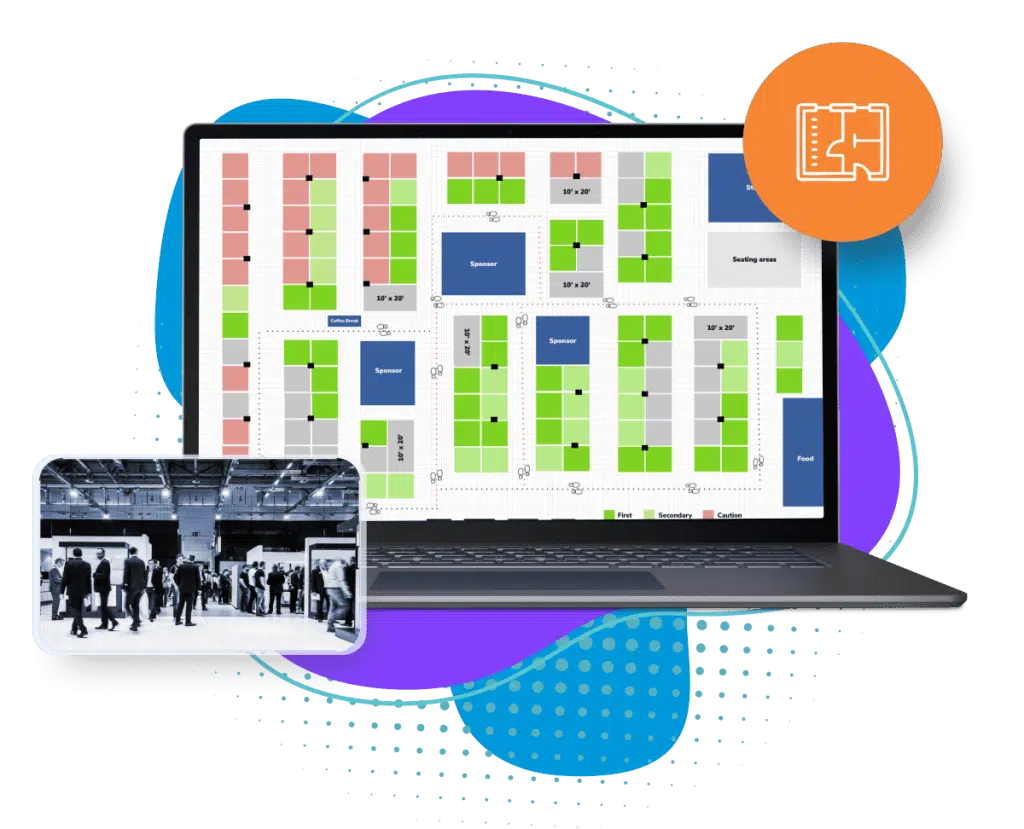
Draw the hall with booths, aisles and open areas, let exhibitors book their booth on it, and update the layout as plans change.
Event floor plan softwareRegistration that feeds check-in
The registration you build is the list you check people in from and print badges for, so there is no spreadsheet between planning and the day.
Event registration softwareCheck-in that works offline
QR check-in on several devices at once, self-service kiosks, and check-ins that keep working in venues with poor or no internet.
Check-in and badge printingPrinters and devices
The badge printers, scanners, tablets and routers the onsite apps support, listed in one place.
Supported devicesThe event app
The agenda, a floor map, event documents and push notifications for last-minute changes, in a branded app.
Event mobile app
The Eventdex platform
The attendee side of your logistics, in one place
- Floor plansInteractive floor plans with booths, aisles and open areas that exhibitors book from.Learn more about Floor plans
- Registration and ticketingRegistration pages, ticket types and payments that become your check-in list.Learn more about Registration and ticketing
- Check-in and badgesQR check-in on multiple devices, offline check-in and on-demand badge printing.Learn more about Check-in and badges
- Check-in kiosksSelf-service check-in and badge printing, with iPads, printers and kiosks available to rent.Learn more about Check-in kiosks
- Event mobile appAgenda, floor map, documents and push notifications for attendees.Learn more about Event mobile app
Further reading
- Effective event planning
- Questions to ask when planning an event
- Event planning checklist
- Run of show: what it is, with a template
- Crowd management at events
- The event planning process
- How to build an event budget
- Why your event needs onsite hardware support
- Common event planning mistakes
- Event staffing guide
- Event signage guide
- Event risk assessment
- Trade show checklist
- Event check-in guide
- Conference planning checklist
- Event volunteer management
“It's easy to use and interfaces very well with our needs. The scheduling function is awesome. It allows our companies and partners to schedule their meetings with no assistance thus reducing time and resources. In addition, if there are any snags in scheduling, the Eventdex staff takes care of your needs immediately.”
 University at Buffalo
 Eversource Energy
 Georgia Tech
 Influence Communications
FAQ
Event Logistics Checklist: common questions
What is the first logistics task for an event?
Confirm the venue and its layout for your headcount, because most other logistics (suppliers, deliveries, power, signage) depend on it.
What is event logistics?
The practical work of getting the venue, people, equipment, supplies and information to the right place at the right time: the venue and layout, suppliers, deliveries, power and Wi-Fi, transport, registration and check-in, staffing and safety.
What should be on an event logistics checklist?
Venue, floor plan, catering, AV, power and internet, deliveries and load-in, transport and parking, accommodation, registration and check-in, badges, signage, staff and volunteers, accessibility, health and safety, exhibitors, and load-out.
What is the difference between event planning and event logistics?
Planning decides what the event is: the goal, audience, program and budget. Logistics makes it happen physically: rooms, deliveries, equipment, transport, queues and people in the right place at the right time.
How far ahead should event logistics be confirmed?
Book the venue 6 to 12 months ahead for a conference and most suppliers 1 to 3 months ahead. Confirm everything in writing about four weeks out, and give catering final numbers about a week before.
Who is responsible for event logistics?
Usually an event or operations manager who owns the master plan, with a named owner for each supplier and area. On the day, keep one person free to solve problems rather than staff a station.
Does Eventdex handle venues and catering?
No. Eventdex is event software covering registration, floor plans, check-in, badge printing and the event app. Venues, catering, AV, transport and staffing are booked with suppliers directly.
How do you manage event logistics?
Keep one master plan with an owner, supplier contact, deadline and status for every area, confirm suppliers in writing, build in buffers, and run the event day from a run of show. The plan template on this page is a starting point.
Is there an event logistics template?
Use the checklist table on this page as the master sheet: add an owner, a supplier contact and a status column to each row. The supplier confirmation email template covers the written confirmations, and the contingency table covers what to do when something fails.
What should I check on a venue site visit?
Loading dock and freight elevator access, power and internet in each room, mandatory suppliers and house rules, accessible routes, exits and the evacuation procedure, and how attendees will flow from the entrance to registration, rooms and catering.
What is an event logistics contingency plan?
A written list of the things most likely to fail, such as internet, deliveries, printers, key people and room capacity, with a backup and a named decision-maker for each. Safety and emergency procedures should follow the venue's plan and local authorities.
What should be done the day before an event?
Walk the venue with the venue manager, set up and test registration, Wi-Fi, power, AV and badge printers, then brief staff and volunteers and share the contact sheet.
Can check-in work if the venue internet fails?
Eventdex's onsite check-in pages describe check-ins that keep working in venues with poor or no internet. Still plan a backup, such as a printed attendee list and a second connection.
Run check-in and floor plans on Eventdex
Start with a free interactive floor plan, or talk to an event specialist on +1 (866) 434-5088.