

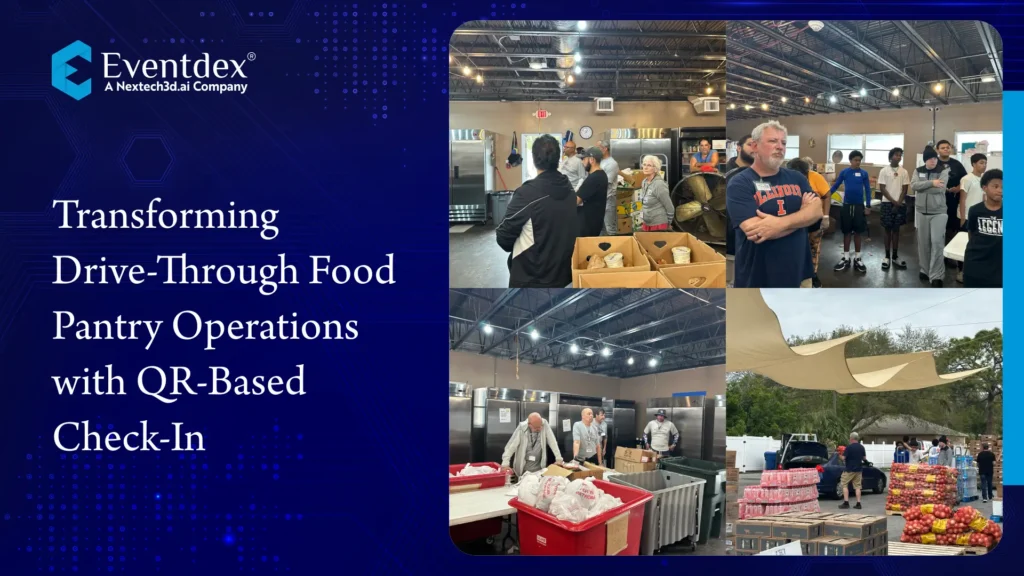
DTI, a food pantry operated by Victor Newman Ministries, needed a faster and more reliable way to manage high-volume food distribution. By implementing the Scan Attendee app developed by Eventdex, a NexTech3D.ai company, the organization significantly improved operational efficiency and volunteer productivity.
Key Outcomes
While the system dramatically improved operational speed and accuracy, the project also revealed an important data reporting limitation. To support grant reporting and long-term community impact analysis, Eventdex will provide a consolidated database solution that enables longitudinal reporting across multiple pantry sessions.
Community food programs play a critical role in supporting families facing food insecurity. Many of these programs operate with limited budgets, volunteer teams, and unpredictable demand. For organizations serving hundreds of households every week, operational efficiency directly affects how many people they can help.
DTI, a food pantry operated by Victor Newman Ministries in Florida, faced exactly this challenge. The organization runs a high-volume drive-through food distribution program serving approximately 300 to 350 households every week. As the pantry expanded, its manual check-in system began creating delays, operational bottlenecks, and data inaccuracies that made it harder to manage large distribution days efficiently.
To improve operations, the team partnered with Eventdex, a NexTech3D.ai company and implemented the Scan Attendee app along with custom QR code identification cards. The new system reduced check-in time from about one minute per client to just a few seconds, allowing volunteers to process vehicles faster and maintain accurate attendance records.
While the solution dramatically improved operational efficiency, the implementation also revealed an important data reporting challenge that affects long-term grant reporting. This case study explores how the new system streamlined weekly operations while also highlighting the next step in building a consolidated reporting database.
DTI operates under Victor Newman Ministries, a nonprofit organization focused on helping individuals and families experiencing food insecurity in Florida. The ministry was founded by Pastor Michael, whose personal experience with homelessness inspired him to create a program that could help people struggling with hunger and financial hardship. What started as a small outreach effort distributing sandwiches eventually evolved into a structured food pantry serving hundreds of families every week.
Today, the organization runs a high-volume weekly drive-through pantry that supports 300 to 350 households during each distribution session. The program has also grown into a community hub, acting as a distribution center for 10 to 12 additional local organizations that rely on the pantry to help deliver food resources to people in need.
Victor Newman Ministries operates as a registered 501(c)(3) nonprofit organization funded primarily through donations and grants. The organization does not receive government operational funding. The program is largely volunteer-driven. Volunteers manage client registration, traffic coordination, and food distribution. Pastor Michael receives a modest quarterly stipend of approximately $2,000, while the rest of the team contributes their time without compensation.
Funding supports operational needs such as truck fuel, packaging supplies, and industrial freezers used to store donated food. With limited resources and a growing demand for services, operational efficiency is essential to sustaining the pantry’s mission.
As DTI’s weekly distribution program expanded, the limitations of its existing event check-in system became increasingly clear. The organization relied on a manual process using Airtable to track client visits. When a vehicle arrived at the pantry entrance, a volunteer searched for the client’s name on a mobile phone and manually marked attendance.
While this process worked when the pantry served a smaller number of families, it became increasingly inefficient as attendance grew.
Slow Check-In Process
Each check-in required approximately one minute per household. With 300 to 350 vehicles arriving during a typical distribution session, the check-in station quickly became a bottleneck.
At peak times, volunteers struggled to keep up with the flow of incoming vehicles. Lines grew longer, and families waited extended periods before reaching the food distribution point.
Difficult Outdoor Conditions
The pantry operates outdoors, often under strong sunlight and high temperatures. These conditions made the manual system difficult to manage.
Volunteers frequently struggled to see mobile phone screens clearly due to glare. Devices sometimes overheated during long distribution periods, which slowed down the check-in process even further.
Risk of Data Errors
Manual searching also increased the likelihood of mistakes. Volunteers occasionally selected the wrong record or checked the wrong box when marking attendance. Even small data errors created challenges for reporting. Accurate attendance records are essential for understanding how many households are served each week and for demonstrating the organization’s community impact to funding partners.
The manual check-in workflow created measurable operational inefficiencies. Key challenges included:
For a volunteer-driven organization serving hundreds of families every week, these inefficiencies placed unnecessary pressure on staff and slowed down the overall distribution process.
Implementing a QR-Based Check-In System
To address these challenges, DTI implemented the ScanAttendee QR check-in system developed by Eventdex. The goal was to eliminate manual searching and replace it with a faster scanning process that could handle high-volume check-ins during weekly food distribution events.
Custom QR Identification Cards
Each pantry client receives a personalized identification card that contains a unique QR code linked to their record. The cards are printed in-house using a heat-activated printer and then laminated to protect them from damage caused by heat and frequent handling.
Producing cards internally allows the organization to control costs while ensuring that each client has a durable ID for future visits. The system also offers flexibility. If a physical card is lost or damaged, volunteers can scan a photo of the QR code stored on the client’s mobile phone.
Using the Scan Attendee app
Volunteers use the Scan Attendee mobile application to scan QR codes as vehicles arrive at the pantry entrance. Instead of searching for names manually, volunteers simply scan the code using the phone camera. The application instantly retrieves the correct record and registers the visit.
This streamlined process replaces several manual steps that were previously required during check-in.
Updated Check-In Workflow
The QR scanning system introduced a structured workflow for managing client visits. New clients complete a paper registration form when they first visit the pantry.
After the event, Frank Meitz enters the client information into the digital system. A QR identification card is printed and prepared for the client’s next visit.
When returning clients arrive at the pantry, a volunteer scans the QR code on their card or phone. The system records the visit immediately. The volunteer then writes the number of food boxes assigned to the household on the vehicle windshield and directs the car through the distribution line where volunteers load the supplies.
Operational Improvements
The implementation of QR scanning produced immediate operational improvements. Before the system was introduced, volunteers spent approximately one minute checking in each household. This created delays during peak arrival periods.
With the Scan Attendee QR scanning system, check-in now takes only a few seconds per vehicle. For a weekly distribution serving 300 to 350 households, the time savings are substantial. Estimated operational gains include:
These improvements allow volunteers to focus on directing traffic and distributing food instead of managing administrative tasks. The scanning process also improved record accuracy. Because each QR code is linked directly to a client profile, the risk of selecting the wrong person has been significantly reduced.
Volunteers also benefit from a simpler interface that works better in outdoor environments where screen glare and device overheating previously caused delays. Overall, the system enables the pantry to serve hundreds of families more efficiently during each distribution session.
Although the QR scanning system dramatically improved operational efficiency, it introduced a new challenge related to long-term data tracking. The Scan Attendee platform uses an event-based model. Each distribution session must be created as a separate event in the system.
For DTI, which operates a weekly food pantry serving 300 to 350 households per event, this means that attendance data is spread across dozens of separate event records over time. To analyze long-term patterns such as visit frequency or geographic trends, volunteers must export data from each event and manually combine the files in Excel. For a volunteer-run nonprofit with limited administrative resources, managing and merging multiple datasets becomes a significant reporting burden.
Why Data Reporting Matters for Nonprofits
Reliable data reporting is critical for nonprofit organizations seeking grant funding and partnerships. Funding organizations often require detailed reports that demonstrate measurable community impact. These reports may include metrics such as the number of households served, repeat visits, and geographic distribution of clients.
One of DTI’s key partners is Feeding Tampa Bay, which supports food distribution programs across the region. To maintain partnerships like this and secure future grants, the organization must be able to show how its services support families in need over time. Without consolidated reporting tools, generating these insights requires extensive manual data work.
Interim Workarounds
To manage some programs more efficiently, DTI continues to use Airtable to track participation in its monthly USDA food distribution program. This approach helps avoid creating additional paid events within the scanning platform. However, it also means that data is stored across multiple systems. Maintaining information in different platforms increases administrative complexity and makes it harder to generate unified reports about overall pantry activity.
The Path Forward: Consolidated Data Reporting
To address the reporting challenge, Eventdex plans to provide a consolidated database solution for DTI. This solution will combine data from multiple pantry sessions into a single reporting environment. The organization will then be able to track client visit history, identify service trends, and generate reports required by grant providers. For DTI, this capability is essential. Accurate reporting strengthens grant applications and helps demonstrate the organization’s long-term impact on the community.
Key Takeaways
DTI’s experience shows how the right technology can significantly improve operational efficiency for nonprofit organizations serving large communities. By implementing QR code scanning through the Scan Attendee application, the pantry replaced a slow manual process with a fast and reliable check-in system. Check-in time dropped from approximately one minute per household to just a few seconds, saving more than four hours of operational processing time during every weekly distribution event.
These efficiency gains allow volunteers to serve 300 to 350 households each week with greater speed and accuracy. At the same time, the project highlighted the importance of long-term data reporting for nonprofit sustainability. With a consolidated reporting database planned by Eventdex, DTI will soon have the tools needed to track community impact more effectively and strengthen future grant applications. For organizations dedicated to fighting food insecurity, improvements like these ensure that more families receive consistent support while maintaining the transparency required for continued growth and funding.


