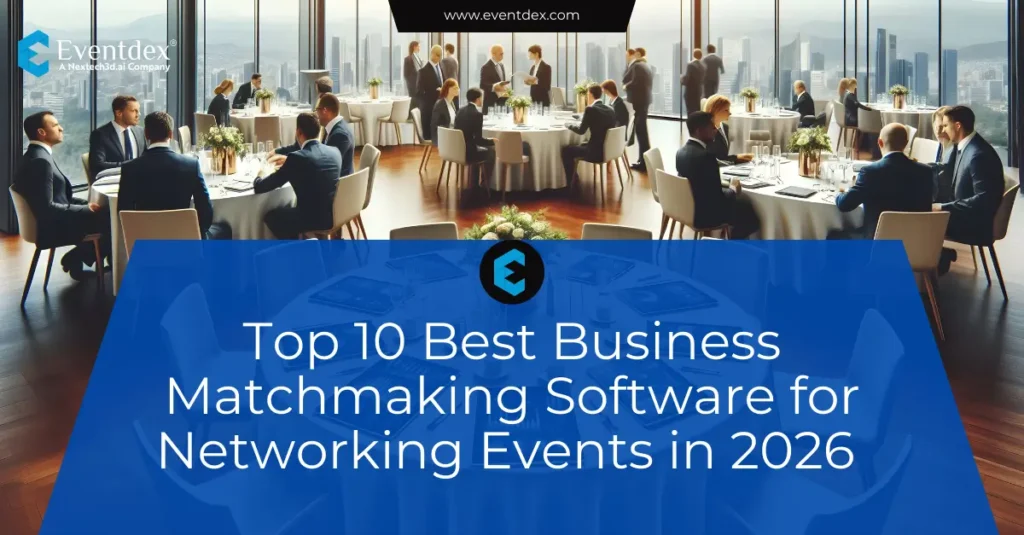
10 Best Business Matchmaking Software for Networking Events in 2026
Business matchmaking software has moved far beyond being a supporting tool for networking events. In 2026, it sits at the center of how value is created, measured, and multiplied inside conferences, trade shows, expos, and high-level B2B forums. What was once driven by chance conversations and manual introductions is now guided by intelligent systems that prioritize intent, relevance, and commercial outcomes.
Today’s AI business matchmaking ecosystem is built for precision. Organizers no longer measure success by footfall alone. They measure it by qualified meetings, conversion velocity, buyer–seller alignment, and long-term relationship value. At the same time, exhibitors and sponsors are demanding a predictable return on participation. This dual pressure has made B2B matchmaking software one of the most commercially important investments for serious event organizers.
This article takes a professional, analytical look at the 10 best business matchmaking software solutions for networking events in 2026, based not only on features, but on market performance, intelligence depth, scalability, and real business impact.
The Strategic Evolution of Business Matchmaking
Early digital networking tools focused on creating digital address books. Attendees created profiles, searched for others, and manually sent meeting requests. While this was an improvement over paper directories, it still relied heavily on user effort and guesswork.
Modern event matchmaking technology operates on a very different model. Today’s systems evaluate behavior, stated intent, interaction history, product relevance, and engagement patterns to surface matches that are commercially meaningful. The rise of AI-powered networking tools has transformed matchmaking from a utility into a revenue accelerator.
In 2026, the best professional networking software platforms do not simply connect people. They actively predict outcomes and optimize human interaction for business performance.
Here is a professionally expanded, AI-focused, publication-ready version of your section. I have kept the tone strategic and directly aligned it with AI-powered matchmaking, while naturally reinforcing the value of business matchmaking software.
What Defines High-Performance Business Matchmaking Software in 2026
Over the past few years, high-performance business matchmaking software has no longer been distinguished by surface-level features or interface design. Instead, they are defined by the depth of their AI-powered matchmaking intelligence, their ability to learn continuously, and their measurable contribution to business outcomes. True market leaders operate as decision-support systems rather than simple networking tools.
-
Match Relevance Accuracy Driven by Advanced AI Modeling
Match relevance accuracy has become the primary benchmark for evaluating business matchmaking software in 2026. Traditional profile-based matching relied largely on static inputs such as job titles, industries, and keyword tags. Modern AI business matchmaking systems go far beyond this approach.
High-performing platforms now leverage multi-layered data intelligence, including:
- Behavioral interaction patterns
- Historical meeting acceptance data
- Engagement depth across sessions
- Product and solution interest signals
- Decision-stage indicators
Through machine learning–driven matchmaking algorithms, these platforms continuously refine how buyer intent is interpreted and matched with supplier readiness. This results in fewer irrelevant meetings, higher-quality introductions, and a measurable increase in conversion-ready conversations. The strongest platforms no longer prioritize connection volume; they prioritize commercial relevance and deal probability.
-
Continuous Learning Through Adaptive AI Engines
The learning capability of the AI engine is now a defining competitive advantage in high-performance business matchmaking software. Static, rule-based systems that rely on fixed filters and preset logic are being rapidly displaced by continuously adaptive AI models.
Modern AI-powered networking tools learn from:
- Declined and accepted meetings
- Post-meeting feedback loops
- Deal progression signals
- Follow-up engagement behavior
- Multi-event participation history
This adaptive intelligence allows the system to fine-tune its recommendations automatically with every interaction. As a result, matchmaking precision improves in real time throughout the event lifecycle and across future events. The platform evolves alongside its audience, ensuring that matchmaking quality does not stagnate but instead compounds in value with every dataset expansion.
-
Enterprise-Grade Scalability Without Performance Degradation
Enterprise scalability is now a non-negotiable requirement for commercially viable business matchmaking software. Leading enterprise networking platforms in 2026 are expected to support:
- Tens of thousands of participant profiles
- High-frequency real-time matching operations
- Complex multi-day agenda structures
- Parallel recommendation engines
- Global user access with zero latency
High-performance platforms achieve this through cloud-native infrastructures, distributed AI processing models, and real-time data synchronization. Importantly, scalability is no longer just about handling volume. It also includes maintaining algorithmic consistency, accuracy, and response speed even under peak usage. Platforms that fail under scale are rapidly excluded from enterprise procurement cycles.
-
Measurable Business Outcomes as a Standard Performance Metric
A business matchmaking software is no longer evaluated by engagement metrics alone. Organizers, exhibitors, and sponsors now demand quantifiable commercial outcomes.
Top-performing platforms demonstrate direct uplift across key revenue indicators such as:
- Meeting acceptance and completion rates
- Sales pipeline acceleration
- Buyer conversion velocity
- Deal quality scoring
- Post-event relationship continuity
Through advanced AI-driven networking analytics, organizations can measure the exact financial contribution of matchmaking activities across the full commercial lifecycle. This shift has transformed matchmaking from a “networking enhancement” into a core revenue accountability system.
Key Factors We Evaluated to Choose the Best Business Matchmaking Software
To identify the most effective business matchmaking software for networking events, we applied a focused evaluation framework based on performance, reliability, and real-world business impact. Each business matchmaking software was assessed on the factors that genuinely influence networking success, not just on feature volume.
Match Quality and Relevance
We prioritized event matchmaking software that consistently delivers relevant, decision-ready connections rather than high volumes of unfocused matches. The ability to align genuine buyer intent with supplier readiness was a primary benchmark.
Scalability and Platform Stability
High-performing B2B Matchmaking software must operate smoothly across large, multi-day events with thousands of participants. Stability under peak usage and consistent performance at scale were essential criteria.
Business Visibility and Measurement
We evaluated how clearly each platform enables organizers and exhibitors to track meetings, engagement, and post-event follow-ups. Systems that provide meaningful visibility into networking performance and outcomes ranked higher.
Integration with Event and Sales Systems
Practical usability depends on how well matchmaking aligns with registration platforms, mobile apps, and sales workflows. Platforms that support smooth data flow across the event ecosystem were prioritized.
User Experience Across Roles
Ease of use for organizers, attendees, and exhibitors was critical. Platforms that balanced functionality with intuitive design consistently outperformed more complex systems.
Security and Data Protection
Given the sensitivity of business data, we assessed essential security standards, access controls, and data protection measures.
Ratings, Reviews, and Market Feedback
Independent user ratings, customer reviews, and real-world feedback were included to validate platform performance beyond marketing claims. Consistent satisfaction scores across multiple review sources strengthened overall rankings.
Commercial Flexibility and Long-Term Value
We considered overall value rather than only upfront pricing, including scalability costs, implementation effort, and long-term operational efficiency.
Market Credibility and Proven Adoption
Platforms with a consistent track record across multiple industries and event formats ranked higher than those with limited real-world deployment.
The 10 Best Business Matchmaking Software Platforms for Networking Events in 2026
-
Eventdex, a Nextech3D.ai Company Business Matchmaking Software

Unlike many event matchmaking software tools that focus only on digital scheduling, Eventdex is deeply optimized for physical event environments. Its speed networking and dynamic table booking functionality automatically allocates meeting spaces based on confirmed appointments, eliminating congestion and inefficiencies on the show floor. The preferential matching framework is particularly powerful for Hosted Buyers Program models, allowing buyers and sellers to define priorities before the event so that meetings are automatically scheduled based on real commercial intent. With unrestricted attendee matchmaking, intelligent appointment orchestration, and high-accuracy preference scoring, Eventdex delivers consistent value as a buyer matchmaking platform, business matching platform, and enterprise-grade Business Matchmaking Solution for revenue-focused networking programs.
Key Features of Eventdex Business Matchmaking Software
- Unified event management and matchmaking, registration, ticketing, and check-in, matchmaking all in one.
- Virtual-event support: enables hosting online or hybrid events with matchmaking functionality.
- Flexible meeting formats: 1-on-1, group meetings, roundtables, pre-scheduled meetings, speed networking, hosted-buyer sessions, and more.
- Mobile/event app support, attendee check-in, scheduling, and AI-powered matchmaking through mobile interfaces.
- Customizable event pages and branding support multi-language, custom domains, email branding, and white-label mobile apps.
- Good customer support and user-friendly design, frequently cited in user reviews.
Pros
- Affordable compared to many enterprise-grade alternatives.
- All-in-one platform reduces the need for multiple tools (registration, matchmaking, check-in, ticketing).
- Easy to use, even for organizers with limited technical expertise.
- Solid hybrid and virtual event support, enabling both online and offline matchmaking.
- Responsive customer service, with event support teams often praised by users.
Cons
- The admin interface can feel cluttered or complex for new users due to the many features.
- Reporting exports (e.g., participant lists) may get cumbersome for very large data sets.
Capterra rating: 4.7/5
-
Brella Business Matchmaking Software

For conferences, investor summits, or professional networking events, Brella works as a business matchmaking solution that prioritizes connection quality and meeting relevance. Its integration capabilities, with registration tools, third-party plugins, and existing tech stacks, make it well-suited for organizers who need matchmaking to plug into their broader event ecosystem.
Key Features of Brella Business Matchmaking Software
- AI-driven business matchmaking and networking recommendations based on attendee intent and interests.
- Scheduling tools for 1:1 or group meetings, with calendar integration and mutual availability management.
- Sponsor and exhibitor tools, including lead scanning, are useful for exhibitor-driven events.
- Communications and content management tools, announcements, session scheduling, and customizable agendas.
- Real-time analytics and meeting-quality feedback (meeting ratings) help organizers and sponsors measure ROI.
Pros
- Excellent matchmaking quality and high meeting acceptance, strong for ROI-driven networking.
- Fully branded/white-label experience, strengthens event branding and professional appearance.
- Robust sponsor/exhibitor features, valuable for trade shows and commercial expos.
- Flexible scheduling (1:1, group, hybrid meetings) adapts to diverse event formats.
- Strong integration capabilities with existing event tech stacks simplify adoption for organizers.
Cons
- Likely a higher price point compared to entry-level tools, may not be cost-efficient for very small events (public pricing not always disclosed).
- For events with low attendee numbers or minimal diversity, the matchmaking potential may be underutilized; matchmaking returns depend on data richness.
Capterra rating: 4.6/5
-
Grip Business Matchmaking Software

Beyond matchmaking, Grip offers a complete event app ecosystem including registration, exhibitor management, badging, scheduling, and post-event lead retrieval, making it a full-suite event matchmaking platform suitable for complex, high-volume events. Its ability to handle hybrid, virtual, and in-person formats adds to its flexibility.
Key Features of Grip Business Matchmaking Software
- Powerful AI-powered business matchmaking that uses over 16 algorithms to match participants based on preferences and behavior.
- Lead management and exhibitor tools, badge scanning, lead scoring, contact export, and follow-up management.
- Post-event analytics and engagement tracking help planners measure meeting success, conversions, and ROI.
- Integration capabilities work as part of a broader event management stack, including registration, content management, sponsors, etc.
Pros
- Very strong matchmaking engine delivering high-quality, relevant matches even for complex events.
- Supports multiple meeting formats, giving flexibility for different event types (trade shows, expos, conferences).
- Full event ecosystem support, registration, badging, exhibitor management, and scheduling, leading to fewer integrations.
- Scalability for large events with many participants, proven track record with big conferences and trade shows.
- Post-event lead management and analytics, valuable for exhibitors and sponsors looking for follow-up business.
Cons
- As a full-suite, enterprise-grade solution, it might be overkill (and over-budget) for small events or simple meetups.
- The complexity of the feature set may require onboarding/training for admin users and participants to use optimally.
Capterra rating: 4.4/5
-
B2Match Business Matchmaking Software

For organizations looking for a virtual business matchmaking platform for events or a B2B online matchmaking solution that supports different meeting types (1-to-1, 1-to-many, many-to-many), B2Match provides considerable flexibility and simplicity. Its community-management features allow for relationship-building beyond a single event, enabling long-term networking value.
Key Features of B2Match Business Matchmaking Software
- Participant and company profiles with detailed custom fields help in precise matchmaking by interest, expertise, and needs.
- AI-powered meeting recommender suggests relevant connections to participants automatically.
- Versatile meeting formats, 1-on-1, group meetings, hybrid or virtual sessions, and online video meetings are built in.
- Messaging and communication tools, real-time chat, meeting requests, notifications, and availability visibility.
- Community & post-event networking supports ongoing engagement beyond the main event through a Community Management Platform license.
Pros
- Highly flexible, adapts to virtual, hybrid, or physical events, and supports different types of meetings.
- Strong B2B matchmaking logic, detailed profiles + AI recommender improve quality of connections.
- Easy to brand and white-label, good for organizations wanting seamless branding and participant experience.
- Built-in video meetings functionality, no need for third-party integrations for virtual events.
- Effective for long-term engagements, the community feature enables follow-up networking beyond a single event.
Cons
- UI and feature-richness may be overwhelming for small-scale events or users unfamiliar with advanced matchmaking setups.
- For maximum benefit, success depends heavily on how well participants complete profiles; poor data leads to sub-optimal matchmaking.
Capterra rating: 4.5/5
-
vFairs Business Matchmaking Software
 vFairs is a well-known platform primarily focused on virtual and hybrid conferences, expos, and fairs, offering a comprehensive virtual matchmaking software component alongside virtual booths, webinars, and content streaming. For organizations aiming to reach a global audience or manage remote participation, vFairs offers a scalable online business matching platform that collapses distance, enabling attendees worldwide to connect.
As a business matching platform, vFairs supports structured networking via matchmaking sessions, virtual booths, and group or one-on-one meetings, making it a viable choice for trade fairs, job fairs, or international B2B expos. Its strength lies in bridging physical absence while still delivering meaningful connections. However, compared to specialized matchmaking-first platforms, vFairs tends to combine matchmaking with broader virtual fair/event delivery, which may dilute matchmaking depth in favour of general event functionality.
Key Features of VFairs Business Matchmaking Software
- Virtual booth exhibition with integrated business matchmaking tools, attendees can visit booths, request meetings or chats with sponsors and exhibitors.
- Virtual and hybrid event support, streaming sessions, webinars, group discussions, and matchmaking all in one environment.
- Built-in chat and video-meeting functionality allows real-time communication even for remote participants.
- Attendee directory and profile management, participants can browse and locate relevant profiles based on role, interest, or industry.
- Event content delivery via webinars, sessions, and resources, making the platform more than just matchmaking (education + networking).
- Scalability for large-scale virtual fairs with global participants, giving organizers the ability to host high-volume events.
Pros
- Strong support for fully virtual or hybrid events, great for global audiences and participants across geographies.
- Integrated fair-plus-matchmaking functionality, useful when the event requires more than just meetings: content, webinars, exhibitor booths.
- Real-time communication options, chat, and video reduce friction for virtual connections.
- Good for exhibitor-driven events, virtual booths with matchmaking increase lead capture opportunities.
- Scales well for large virtual fairs.
Cons
- Matchmaking depth may not be as advanced as specialized AI-first matchmaking software.
- As the platform is fairly broad (fair management + matchmaking + content), some matchmaking-specific customizations may be limited.
Capterra rating: 4.8/5
-
Swapcard Business Matchmaking Software

What sets Swapcard apart is its balance between ease of use for attendees and depth of networking for organizers. By supporting features like hosted buyer programs, 1:1 meetings, group sessions, and virtual/hybrid formats, Swapcard works well for organizers who want a flexible but professional business matching platform that doesn’t over-complicate the user experience.
Key Features of Swapcard Business Matchmaking Software
- Rich attendee/exhibitor profiles with detailed focus areas, interests, enabling more precise matchmaking.
- AI-generated match recommendations based on profile data and behavior (booth visits, interests), supporting virtual B2B matchmaking platform needs.
- Meeting scheduling (1:1 or group), with calendar sync, virtual or physical location assignment.
- Hosted buyer program support, designed for buyer-seller matchmaking at expos and trade shows.
- Lead-scanning and exhibitor tools, badge or visitor tracking for onsite or virtual leads, and managing follow-up after meetings.
- Real-time networking analytics helps organizers and exhibitors gauge meeting acceptance rates, engagement metrics, and ROI.
Pros
- Powerful matchmaking that balances simplicity (for users) and depth (for organizers), good for expos and hybrid events.
- Hosted buyer program functionality aligns with the use case for trade shows and buyer-seller matchmaking.
- Supports both virtual and physical meeting flows, ideal for hybrid events and global audiences.
- Rich attendee/exhibitor profiling helps match on more than just job titles (industry, needs, interests).
- Good analytics capability helps organizers justify ROI and exhibitors track leads.
Cons
- As with many hybrid platforms, effectiveness depends significantly on participants completing their profiles fully; partial data reduces matchmaking accuracy.
- For very niche or small groups, the volume of matches may be limited, reducing the benefit of the AI-recommendation system.
Capterra rating: 4.3/5
-
MeetMatch Business Matchmaking Software

MeetMatch stands out for events that rely on organized 1-on-1 or small group meetings between buyers and sellers rather than broad networking sessions. Its focus on structured scheduling and match facilitation, rather than just attendee discovery, makes it valuable for ROI-driven B2B events.
Key Features of MeetMatch Business Matchmaking Software
- Profile-based matchmaking allows attendees to set business interests and needs for better targeted connections.
- Hybrid and virtual meeting support for remote attendees or global buyers.
- Meeting management and calendar integration, helping participants plan and manage their agenda.
- Exhibitor & sponsor interaction tools, to support lead generation and follow-up after meetings.
- Event registration and attendee directory features, combining matchmaking with basic event management.
Pros
- Well-suited for structured B2B meetings and buyer-seller matchmaking at expos and trade events.
- Supports both virtual and in-person formats, useful for hybrid or global events.
- Helps organizers coordinate meetings efficiently, improves event flow, and reduces administrative overhead.
- Enables focused matchmaking rather than random networking, beneficial for participants who are serious about leads.
- Often more cost-effective than full-scale enterprise platforms, making it accessible for mid-size events.
Cons
- Interface and feature set may not be as advanced as larger platforms, with less support for advanced analytics or exhibitor tools.
- Less public documentation/data available, harder to evaluate by new users without a demo or trial.
Capterra rating: 4.6/5
-
Cvent Attendee Hub Business Matchmaking Software
 Cvent Attendee Hub is part of the broader suite offered by Cvent and brings together event management, registration, content delivery, and networking capabilities. As a business matchmaking software option integrated into a larger event management ecosystem, it’s best suited for large conferences, enterprise summits, and professional gatherings that require a full-service solution.
For organizations already using Cvent’s registration or event management tools, Attendee Hub serves as their event matchmaking platform add-on, providing attendee directories, session scheduling, and networking modules. This can make it efficient for enterprise clients who value integrated workflows over standalone matchmaking tools.
Key Features of Cvent Business Matchmaking Software
- Participant directory and profile management for attendee discovery and networking.
- Session scheduling and agenda management align networking with event content.
- In-app messaging/communication features facilitate attendee-to-attendee contact.
- Integration with Cvent’s broader event management stack, seamless registration, check-in, badge printing, etc.
- Support for hybrid events, combining virtual and in-person attendees in a unified platform.
- Analytics dashboards for attendee engagement, session attendance, and networking activity (depending on plan).
Pros
- Seamless integration with full-scale event planning and management tools reduces vendor management complexity.
- Reliable infrastructure with enterprise-level support, good for large-scale, high-stakes events.
- Handles hybrid events, useful when attendees are spread globally, or some prefer virtual attendance.
- Reduces the need for a separate matchmaking solution if the event is already managed in the Cvent ecosystem.
Cons
- As part of a larger suite, matchmaking features may be more basic compared to specialized “matchmaking-first” platforms.
- Potential cost overhead when using the full platform might be expensive for smaller events or budgets.
Capterra rating: 4.7/5
-
Accelevents Business Matchmaking Software
 Accelevents is primarily known as an event management and virtual/hybrid event platform but its support for networking and matchmaking functionality makes it a viable b2b matchmaking software for organizations hosting expos, conferences, or hybrid trade shows. Its flexibility and relative affordability compared to enterprise-grade alternatives make it attractive for associations, SMEs, and niche events.
For events where ticketing, registration, content delivery, and matchmaking all need to coexist, without investing in heavyweight enterprise solutions, Accelevents presents a balanced business matchmaking solution. It may not have the depth of AI-driven matchmaking engines, but its simplicity, cost-effectiveness, and ease of deployment make it worth considering for small-to-medium B2B events.
Key Features of Accelevents Business Matchmaking Software
- Virtual and hybrid event support, enabling remote or mixed-attendance events with networking features.
- Basic attendee directory and matchmaking or connection request functionality help attendees connect pre- and post-event.
- Integrated registration, ticketing, and payment collection simplifies the overall event workflow.
- Session scheduling, live streaming, content delivery, and webinars, combining content + networking in one platform.
- Chat and communication tools, allowing attendees to message each other or exhibitors directly.
- Lead capture and basic reporting tools, facilitating post-event follow-up for B2B connections.
Pros
- Budget-friendly compared to enterprise matchmaking suites, good for small to mid-size events.
- All-in-one platform: registration, ticketing, content, and matchmaking together , reduces complexity.
- Supports hybrid and virtual events, helpful for global reach or remote participants.
- Easy to deploy, manage, and use without extensive technical setup, accessible to small teams.
- Lower resource overhead compared to large enterprise tools, cost-effective for NGOs, trade associations, SMEs.
Cons
- Matchmaking functionality is more basic than specialized event matchmaking software, and may not deliver the same quality of matches.
- Less advanced analytics and exhibitor tools limit the ability to measure business outcomes compared to top-tier platforms.
Capterra rating: 4.6/5
-
Whova Business Matchmaking Software

For organizations that wish to offer more than just one-on-one meetings, such as community conferences, professional panels, or knowledge-sharing events, Whova’s integrated approach works well. While it may not emphasize deep matchmaking sophistication as much as AI-first platforms, its balanced mix of features makes it suitable for mid-sized to large events, especially those where attendee engagement and content matter as much as networking.
Key Features of Whova Business Matchmaking Software
- Attendee directory and profile browsing, enabling participant discovery before, during, and after events.
- Meeting scheduling and connection requests, facilitating 1-on-1 interactions between attendees, sponsors, or exhibitors.
- Session schedules, agenda management, and content delivery support events with seminars, panels, and networking.
- In-app messaging and communication tools aid attendee interaction and follow-up.
- Hybrid and virtual event support, useful for remote participants or global audiences.
- Event engagement features like community boards, Q&A, and session feedback enhance overall attendee experience beyond meetings.
Pros
- Balanced approach: content, community engagement, and matchmaking, ideal for conferences with learning + networking.
- User-friendly interface and cross-platform support, attendees often find setup and usage straightforward.
- Supports hybrid or virtual events, adds flexibility for event organizers.
- Good for events where networking is one among several event objectives (not just deals).
- Simplifies vendor management by combining multiple event tools (agenda, content, networking) in one platform.
Cons
- Matchmaking depth and targeting may be less advanced than specialized AI-driven platforms.
- Less emphasis on exhibitor lead management or advanced B2B sales-oriented matchmaking may limit value for B2B trade shows prioritizing deals.
Capterra rating: 4.5/5
Conclusion
Networking success is no longer measured by how many connections are made, but by how many meaningful business relationships actually move forward. The rise of intelligent business matchmaking software has reshaped how events deliver value, shifting the focus from random introductions to well-aligned, outcome-driven meetings. Organizers, exhibitors, and buyers now expect networking to be structured, measurable, and commercially relevant.
Among the platforms driving this shift, Eventdex, a Nextech3D.ai company, has positioned itself as a clear leader for enterprises that demand more than surface-level engagement. With a strong foundation in data-driven matchmaking, enterprise scalability, and integrated event performance visibility, Eventdex enables organizers to design networking experiences that convert into pipeline, partnerships, and long-term revenue.
If you are planning high-stakes conferences, hosted buyer programs, exhibitions, or virtual networking experiences in 2026, this is the moment to upgrade from basic networking tools to a true business matchmaking solution.
Book a personalized demo with Eventdex today and turn networking into predictable business outcomes.
Frequently Asked Questions (FAQs)
What is business matchmaking software?
It is a technology platform that connects buyers, sellers, and decision-makers based on relevance, intent, and business goals.
How is business matchmaking different from basic networking apps?
Business matchmaking focuses on qualified meetings and deal-driven connections, not just social interaction.
Is business matchmaking only for large enterprise events?
No. It is highly effective for mid-sized conferences, trade shows, hosted buyer programs, and virtual summits as well.
Can matchmaking work for virtual and hybrid events?
Yes. Most modern platforms support in-person, virtual, and hybrid matchmaking formats.
How do hosted buyer programs benefit from matchmaking software?
It ensures pre-qualified buyer-seller meetings, higher conversion rates, and stronger ROI for both sides.
Does matchmaking software integrate with registration platforms?
Most leading platforms integrate with registration, mobile apps, CRM systems, and email marketing tools.
How are matches usually created?
Matches are generated using profile data, preferences, behavior, past interactions, and meeting intent.
Is data security a concern in matchmaking software?
Top platforms follow enterprise-grade security standards with encrypted data and access controls.
How soon can matchmaking be activated for an event?
Most platforms can go live within a few days once registration data and event setup are completed.
Which platform is best for enterprise-scale networking events in 2026?
Eventdex is widely preferred for large-scale conferences, exhibitions, and hosted buyer programs due to its scalability and measurable business outcomes.